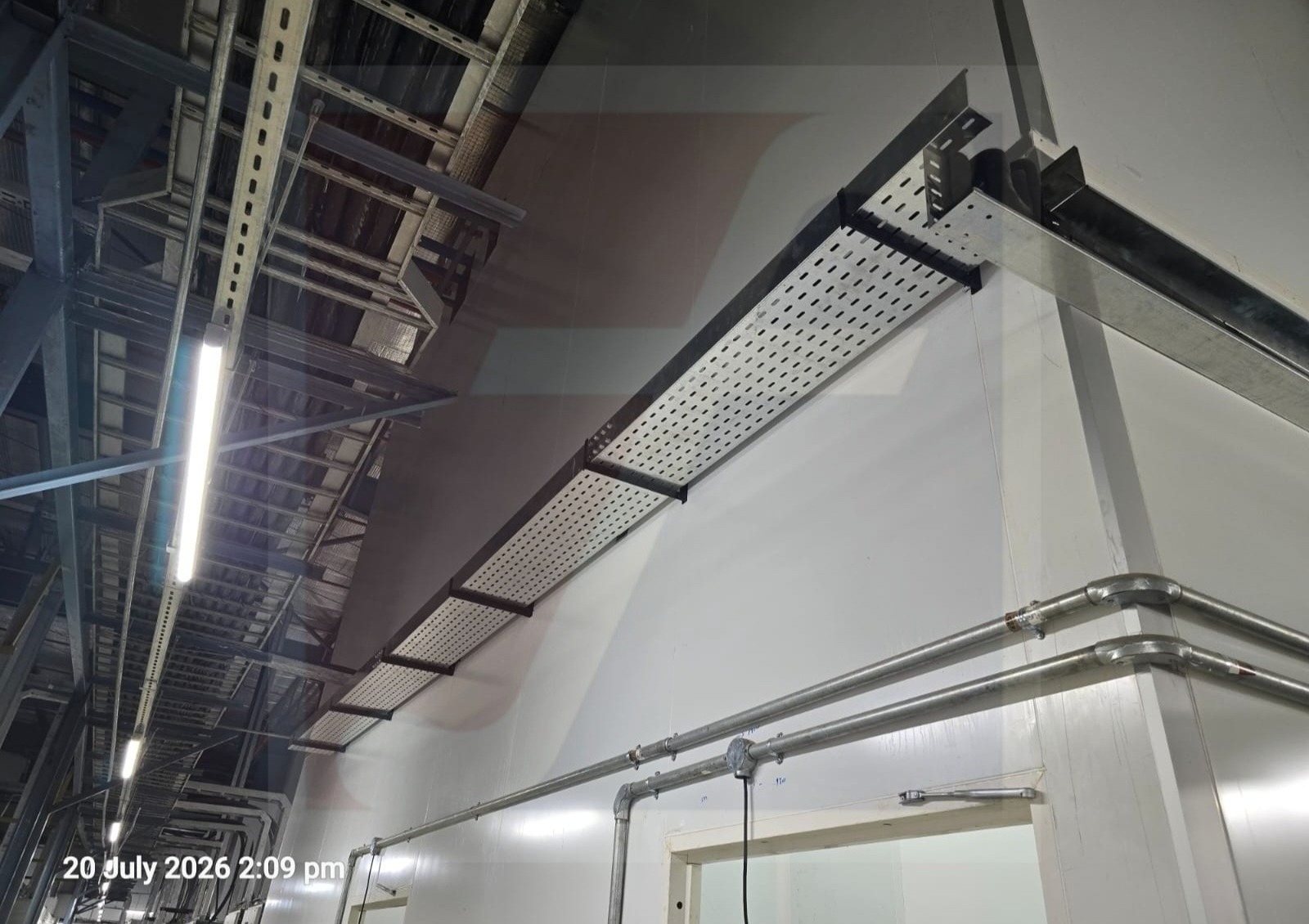
Ordering perforated cable tray accessories becomes easier when procurement begins with a precise specification. Terms such as "bend," "tee" or "reducer" identify the general component, but they may not provide enough information for accurate manufacturing.
For businesses searching for a Perforated Cable Tray Accessories Manufacturer in Kochi, a structured checklist can help reduce specification gaps before purchase orders are finalized.
1. Confirm the Main Tray Dimensions
Accessories must correspond with the relevant perforated tray system. Record the required tray width, depth and other applicable dimensions.
Avoid assuming that an accessory described only by its nominal width will automatically match every tray with the same general description.
2. Define the Accessory Type
Use the electrical route drawing to identify the required components. These can include:
- Horizontal bends
- Vertical bends
- Tees
- Crosses
- Reducers
- Couplers
- Covers
- Other project-specific components
Where direction or angle is relevant, specify it clearly.
3. State Material and Thickness
The accessory specification should be coordinated with the approved tray requirement. Material and thickness should therefore appear clearly in the enquiry or bill of quantities.
This prevents procurement teams from comparing quotations based on components that are not technically equivalent.
4. Specify the Required Finish
Surface finish should follow project specifications and environmental requirements. The selected finish should be stated rather than left to assumption.
5. Check Transition Requirements
Reducers deserve particular attention because the incoming and outgoing widths need to be identified correctly. If a cable route changes from one tray size to another, both dimensions should be included in the requirement.
6. Verify Quantities Against Drawings
Accessory quantities should ideally be checked against the latest approved cable-routing drawings. Revisions to electrical layouts can alter the number of bends, branches and transitions required.
Procurement in Kochi
Projects in Kochi and other parts of Kerala may involve cable routes ranging from relatively straightforward commercial layouts to extensive industrial networks. Detailed accessory schedules make manufacturing enquiries more precise in either case.
Fixotech Engineering Systems Pvt Ltd manufactures perforated cable trays and corresponding accessories for cable management requirements.
The practical purchasing rule is simple: do not specify accessories in isolation. Match each component to the associated tray type, dimensions, material and finish. A complete specification helps manufacturers quote the correct configuration and enables buyers to compare equivalent products more accurately.