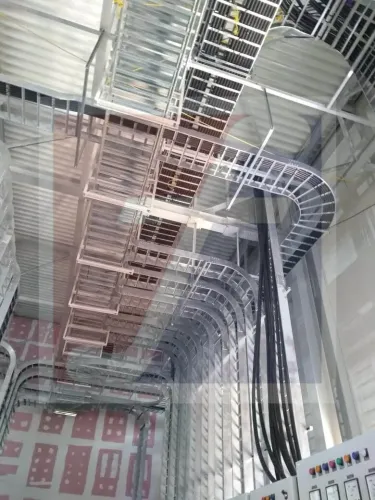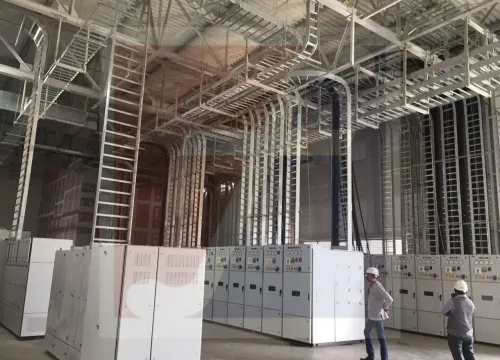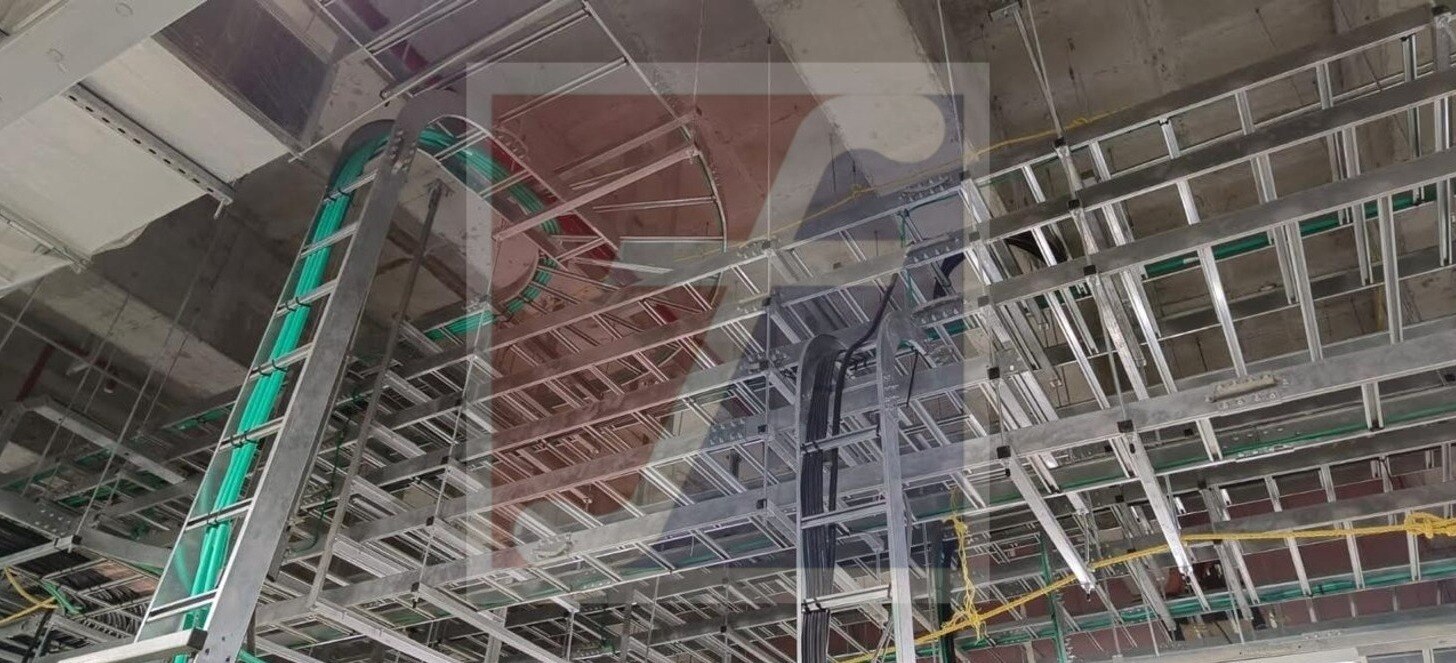
A bend cannot be specified safely by angle alone: the tray width, side-rail dimensions, radius, joint pattern, finish, and cable requirements all affect whether it will fit and perform. By the end, you will be able to read a plan, prepare a complete fitting specification, check cable routing through the corner, and compare quotations delivered in Kochi.
Key takeaways
- Specify tray width, rail height, angle, and inside or centreline radius.
- Protect cable bend radius and separation through every horizontal turn.
- Compare prices using identical materials, gauges, radii, hardware, and quantities.
- Include bends, joints, covers, supports, bonding parts, and fasteners in the take-off.
Specify the bend with dimensions, not only an angle
Identify a horizontal bend for ladder tray by its tray width, side-rail height, bend angle, and inside or centreline radius—not by “90°” alone. A 30°, 45°, 60°, 90°, or custom angle changes the route and the required fitting dimensions.
1. Mark the plan direction: left or right, horizontal elevation, angle, and cable arrangement through the turn. Check the bend radius against the minimum bend radius printed on every cable datasheet; a tight fitting can damage insulation or force excessive side pressure.
2. State the tray width, side-rail height, side-rail profile, rung spacing, material thickness, finish, overall length, usable cable space, inside radius, and tangent lengths. Ask for a dimensional drawing or catalogue code showing these measurements.
3. Match the bend to the straight tray’s splice-plate pattern and connection-hole layout. Confirm whether it arrives as a complete assembly or loose components, and request the required splice kits, fasteners, bonding jumpers, and earth-continuity arrangement.
4. Request load data for the bend itself, including support span, loading arrangement, and deflection criterion. For IEC-based work, identify the applicable IEC 61537 edition and the test basis.
5. For a ladder tray horizontal bend price in Kochi, require separate lines for angle, dimensions, radius, thickness, finish, splice-kit inclusion, quantity, packing, GST, and delivery to site. Otherwise, two prices can describe different fittings. A horizontal bend is not an inside vertical bend, outside vertical bend, tee, or reducer.
Read the plan and protect cable geometry through the turn
The plan-view route determines whether the fitting turns left or right. Trace the tray centreline from the incoming straight section to the outgoing section, then note the included angle: 30°, 45°, 60°, 90°, or a project-specific angle. Do not infer direction from the drawing sheet’s north arrow; use the tray route and equipment connection points.
Ask the ladder cable tray bend supplier for a dimensional drawing or catalogue code, then check:
- Inside radius and centreline radius, with the reference clearly identified
- Tray width, side-rail height, overall length, tangent lengths, and usable cable space
- Side-rail profile, rung spacing, splice-plate pattern, and connection-hole layout
- Whether the part is a complete assembly or loose rails, rungs, plates, and fasteners
A horizontal bend for ladder tray must protect the largest cable’s installation geometry, not merely fit the tray. Compare the bend radius with the minimum bending radius printed on each cable datasheet; the fitting’s radius does not guarantee compliance after installation.
Mark parallel power circuits on the plan before approving the bend. Keep phase or circuit order and the specified separation through the turn, and reserve room for cleats. Packing heavy cables against the inside rail can create excessive sidewall pressure, disrupt spacing, and make the required cleat arrangement impossible.
Confirm the bend’s tested or calculated load data separately, including support span, loading arrangement, and deflection criterion.
Match the fitting, joint hardware, loading, and bonding requirements
A bend is mechanically compatible only when its side rails, hole pattern, and joint elevation match the straight tray—not merely its nominal width.
Ask a ladder cable tray bend supplier for a dimensional drawing or catalogue code showing the inside or centreline radius, overall dimensions, tangent lengths, side-rail profile, rung spacing, connection-hole layout, and whether the price covers a complete assembly or loose components.
Before approval, match these items against the straight ladder tray:
- Tray width, side-rail height, material, finish, and rung spacing.
- Splice-plate shape, bolt diameter, nut type, washer arrangement, and hole pattern.
- The bend’s rated load and deflection at the project’s support span, including the cable load entering the fitting.
- The applicable IEC 61537 edition and the mechanical test basis for the offered bend when the specification uses IEC requirements.
Do not mix fittings from different tray systems without written compatibility confirmation. Equal widths can hide different rail profiles or bolt elevations, leaving an unsupported or distorted joint.
Check the radius against the largest cable’s minimum bending radius from its datasheet. The tray fitting does not enforce that cable limit.
Electrical continuity needs its own check. Confirm whether the bend and splice are part of the protective or equipotential-bonding path, then specify bonding washers, bonding links, or a separate jumper where paint, coating, loose joints, or dissimilar hardware interrupts metal-to-metal contact. Measure continuity across the completed bend and splice using the project’s approved test method.
Compare ladder tray horizontal bend prices in Kochi on an equal basis
A ladder tray horizontal bend price in Kochi is comparable only when every quotation describes the same fitting and delivery basis. Request a dimensional drawing or catalogue code showing the bend angle, inside or centreline radius, tray width, side-rail depth, overall dimensions, tangent lengths, usable cable space, side-rail profile, rung spacing, and joint-hole pattern.
| Quotation item | What to confirm | Why it affects comparison |
|---|---|---|
| Tray specification | Width, side-rail depth, material thickness, finish, angle, and radius | A 90° bend in 300 mm tray is not equivalent to one in 600 mm tray |
| System compatibility | Splice-plate pattern, connection-hole layout, loose or complete assembly, and splice-kit contents | A low price can exclude hardware needed to connect it |
| Mechanical data | Rated load, support span, loading arrangement, and deflection criterion | A bend’s rating is not automatically the same as the straight tray |
| Commercial basis | Quantity, packing, GST, freight, and delivery to your site in Kochi | Different tax and delivery assumptions distort the unit price |
| Compliance evidence | Applicable IEC 61537 edition and test basis | You can distinguish tested performance from an unsupported claim |
If you are assessing a cable accessories manufacturer ladder tray for horizontal bend in Kochi, ask for the same documents and line-item breakdown from every bidder.
Fixotech Engineering Systems Pvt Ltd: Manufacturer of Cable Management Systems can be included in that comparison when its drawing, load data, hardware scope, and delivered price are stated on the same basis.
Build the complete ladder tray accessories take-off
Put the bend into a complete system take-off: a 90° fitting without its mating tray, splice hardware, or support count can stop installation on site. Treat ladder tray accessories in Kochi as a coordinated purchase order, not a bend-only enquiry.
- Fittings: straight lengths, 30°, 45°, 60°, 90° and custom horizontal bends, vertical bends, tees, crosses, reducers, end plates and covers where specified.
- Supports: cantilever brackets, trapeze frames, threaded rods, clamps, base plates and the required anchors, sized for the tray load and support spacing.
- Connections: splice plates, bolts, nuts, washers, bonding jumpers and fasteners compatible with the tray material and finish.
- Documents: catalogue code, dimensional drawing showing inside radius, overall dimensions, tangent lengths, side-rail profile, rung spacing and joint-hole pattern; identify whether each fitting is a complete assembly or loose components.
- Compliance: state the applicable IEC 61537 edition and test basis, or NEMA VE 1 classification; do not treat either classification as automatically equivalent to the other.
| Purchase line | Evidence to require | Site check |
|---|---|---|
| Fittings and joints | Width, side-rail height, thickness, radius and hole layout | Match the delivered parts to straight-tray profiles |
| Supports | Load rating, bracket type and spacing schedule | Confirm anchors, elevations and obstruction clearances |
| Cables and route | Cable datasheet minimum bend radius and route drawing | Confirm usable space and cable separation through the turn |
| Finish and bonding | Coating specification, continuity method and jumper quantity | Inspect damage, continuity and dissimilar-metal contact |
Frequently asked questions
What dimensions must you specify for a ladder tray horizontal bend?
State the tray width, side-rail height, bend angle, and inside or centreline radius. Also identify the material, thickness or gauge, finish, and connection method.
How do you protect cables through a horizontal ladder tray bend?
Read the route plan, check each cable’s minimum bend radius, and select a bend radius that preserves cable geometry without crushing, crowding, or forcing cables against the rails.
How should you compare ladder tray horizontal bend prices in Kochi?
Compare quotations with the same width, rail height, angle, radius, material, thickness, finish, loading basis, joint hardware, bonding provisions, and quantity.
What belongs in a ladder tray accessories take-off?
List horizontal bends, straight sections, reducers, tees, crosses, risers, joint plates, fasteners, covers, supports, clamps, bonding jumpers, and earthing connections required by the route.