Tray choice problems usually begin with a nominal width selected before anyone checks cable diameters, total mass, support spans or the installation environment. By the end, you will be able to size a perforated tray from the cable schedule, reject unsuitable alternatives and request evidence that makes supplier comparisons technically meaningful.
Key takeaways
- Size tray width from cable diameters, spacing and future capacity.
- Check load, support span and deflection before approving tray thickness.
- Match tray material and finish to Kochi’s humidity, salt and chemical exposure.
- Reject perforated tray where segregation, shielding or environmental protection is required.
How do you select perforated tray width and depth from the cable schedule?
Start with the cable schedule, not a catalogue width. For cable tray selection in Kochi, record each circuit’s outside diameter, quantity, mass per metre, minimum bend radius and installation grouping before choosing the section.
Use this checklist for every cable group:
- Confirm outside diameter and quantity, including single-core spacing.
- Record mass per metre for load calculations.
- Mark the largest minimum bend radius.
- Identify grouping with power, control, instrumentation or data cables.
- Define the percentage or number of spare cables required.
Calculate occupied area or usable width from the actual cable arrangement, then add a stated future allowance. Do not fill the tray to its edge. Select width for the arrangement and side-rail depth to prevent excessive stacking while leaving space for cleats, ties, dividers and a specified cover.
A wider tray is not automatically stronger or thermally better. Strength depends on material, thickness, profile and support span; ampacity depends on spacing, grouping, ambient temperature, solar exposure and cover-related correction factors from the cable manufacturer.
Check the largest cable’s bend radius at every elbow, tee, reducer and riser. A straight run that fits can still fail at a fitting, causing pulling damage or an unusable route.
Treat cable fill as a calculation, not a visual judgement. These checks prevent tray choice problems before procurement and expose why tray width alone cannot establish either mechanical capacity or allowable cable current.
How do load, support span and deflection determine the tray specification?
Calculate the design load in kg/m: actual cable mass per metre + future-cable allowance + cover weight + divider weight + cleats + couplers + other accessories. Compare that total with the manufacturer’s allowable load at the proposed span; an unqualified “heavy duty” label does not resolve tray choice problems.
Require a load-versus-span table with these declarations:
| Span | Allowable load (kg/m) | Permitted deflection | Tray width and depth | Material and thickness | Support arrangement |
|---|---|---|---|---|---|
| Each proposed span | Manufacturer’s tested value | Stated limit | Exact section | Exact specification | Supports, joints and couplers |
Longer spans increase bending demand and deflection. A concentrated bundle can overload one section even when the route’s average kg/m appears acceptable, so check local cable concentrations and place closer supports near fittings, vertical runs and heavy bundles.
Install joints and couplers only where the tested support arrangement permits them. A joint midway between supports requires written manufacturer approval; otherwise, the connection can become the failure point. Review seismic forces, vibration and machinery areas separately, including bracing and restraint requirements rather than treating ordinary horizontal supports as sufficient.
Which tray material, thickness and finish suit Kochi’s exposure?
Choose the corrosion system before comparing prices. Indoor plant rooms, roof-level routes, rain-exposed areas, coastal salt and chemical zones demand different protection.
| Option | Specify precisely | Best fit |
|---|---|---|
| Pre-galvanized steel | Zinc coating applied to sheet before fabrication; state sheet thickness, coating designation and conformity requirement | Dry indoor routes with protected cut edges |
| Hot-dip-galvanized-after-fabrication steel | Fabricated tray and fittings immersed after cutting and drilling; state coating thickness and conformity requirement | Humid, roof-level or rain-exposed routes |
| Stainless steel | State grade, sheet thickness and finish | Coastal salt, washdown or aggressive chemical exposure |
| Non-metallic system | State resin or material, thickness, load rating and fire-performance data | Chemical zones or corrosion conditions that attack coated steel |
Do not accept “galvanized” without the process, coating thickness and conformity document. Request section width, side-rail depth, sheet thickness, perforation pattern, cover thickness and fitting construction. Inspect coated steel after cutting, drilling, transport or site modification; repair damaged protection using the specified system.
A perforated tray in Kochi improves heat release, visual inspection and tie access, but perforations are not drainage or ingress protection. A cover limits falling water and impact, yet adds load and can reduce cooling. Small or flexible cables can sag through large openings; specify a solid-bottom liner, basket or closer support.
Include cover weight in the load review.
When is a perforated tray the wrong cable-routing choice?
Perforated tray is the wrong choice when its openings cannot support the cable or the route needs enclosure. Use a perforated tray in Kochi when inspection, tie access and ventilation matter, and cable diameters remain supported without sagging into the holes.
| Option | Choose it when | Main limitation |
|---|---|---|
| Ladder tray | Heavy power cables, large bundles, reduced bearing area and maximum heat release matter | Cables need cleats or ties, and small cables need a liner |
| Solid-bottom tray or liner | Control, instrumentation, fire-alarm and data cables could sag through perforations | Less drainage and visibility |
| Wire mesh tray | Lightweight data or control routes need small openings, low weight and frequent changes | Not the choice for rigid, heavy-duty support |
| Conduit or enclosed raceway | Dust, falling water, impact, unauthorised access, electromagnetic control or hazardous-area rules demand enclosure | Installation and access take more time |
A cover does not automatically make a tray watertight, fire-rated or thermally equivalent to an open route; include its weight and reduced ventilation in the design. Check grouping, spacing and ampacity correction factors before mixing power, signal or intrinsically safe circuits.
- Use a divider or separate tray when voltage, signal type, shielding or EMC requirements demand separation.
- Choose closer support or a solid liner when flexible cables settle into openings.
- Detail a tested firestop at every fire-rated wall or floor penetration.
What should you request from a Kochi tray manufacturer before approving the layout?
Approve the layout only after converting the routing drawing into a procurement specification. Separate power, control, instrumentation, data, fire-alarm and intrinsically safe circuits by voltage, signal type, shielding, EMC requirements and governing installation rules. Show separate trays, metallic dividers or defined crossing arrangements; spare space is not separation.
Request these items from every perforated cable tray supplier:
- Section width, side-rail depth, thickness, material and coating designation.
- Load-versus-span tables stating allowable kilograms per metre, support arrangement and deflection limit.
- Permitted supports, fitting details, coupler strength, expansion-joint instructions and joint locations.
- Minimum bend radii, vertical drops, access points and bonding-jumper provisions.
- Electrical-continuity provisions and IEC 61537 conformity or test documentation, where applicable.
- A tested, compatible firestop system for every tray penetration through a fire-rated wall or floor. A cover does not create a fire-rated barrier.
| Layout evidence | Procurement evidence | Approval test |
|---|---|---|
| Separate routes or dividers | Dimensions, material, coating and fittings | Circuits meet separation and EMC rules |
| Marked supports and joints | Load, span, deflection and coupler data | Design load fits declared capacity |
| Bend radii and penetrations | Firestop and bonding details | Installation remains serviceable and continuous |
Fixotech Engineering Systems Pvt Ltd: Manufacturer of Cable Management Systems can respond to a customized schedule, but compare declared data, not location, catalogue width or price. The phrase “cable for management systems manufacturer in Kochi for perforated tray selection” describes search intent, not a technical specification.
Related product
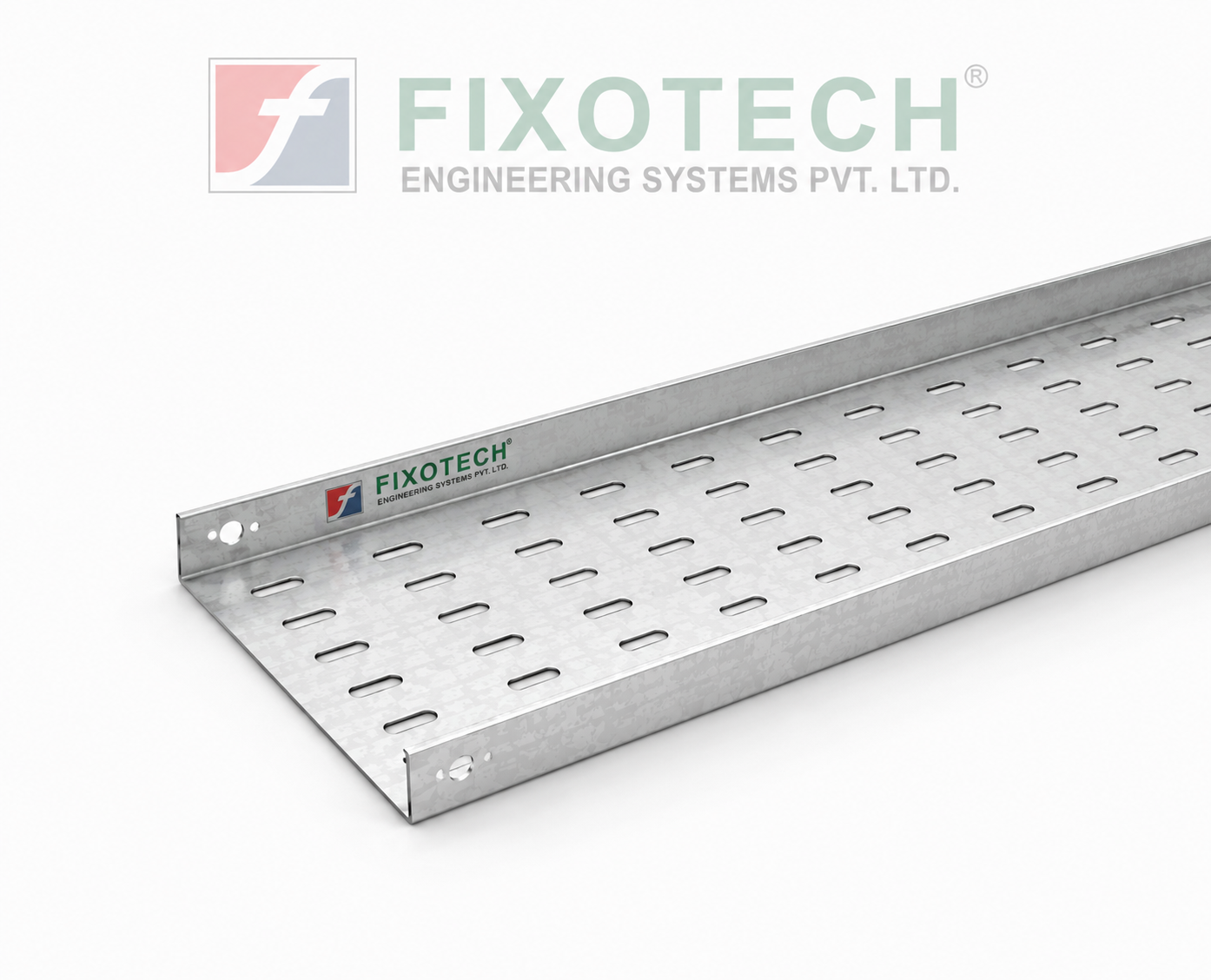 | PERFORATED CABLE TRAY Perforated Tray In electrical systems, a perforated cable trayeither with or without coversis a typical part used to support and arrange cables. View product → |
Frequently asked questions
How do you select perforated tray width and depth from the cable schedule?
Record every cable’s outside diameter, quantity, mass per metre, minimum bend radius and grouping. Add the cable diameters, required separation and planned spare capacity to determine tray width; choose depth so cables remain within the usable side-rail height without crowding or exceeding bend-radius limits.
How do load, support span and deflection determine the tray specification?
Calculate the total cable mass per metre, add the tray self-weight and apply the project’s design factor. Check that the selected tray carries this load at the actual support span, then verify the manufacturer’s deflection data and allowable limit for that span.
Which tray material, thickness and finish suit Kochi’s exposure?
Assess indoor humidity, outdoor rain, coastal salt, washdown water and chemical exposure before choosing material and finish. Compare galvanised steel, hot-dip galvanised steel, stainless steel and aluminium by corrosion risk, strength, weight and required thickness; request coating details and test documentation.
When is a perforated tray the wrong cable-routing choice?
Choose another system when cables need a sealed barrier against water, dust or chemicals, strong electromagnetic shielding, fire-rated containment, strict circuit segregation or protection from impact. Ladder tray, solid-bottom tray, raceway or conduit may suit those conditions better.
What should you request from a Kochi tray manufacturer before approving the layout?
Request a dimensioned layout, tray width and depth, material grade, thickness, finish, load table, support-span recommendation, deflection data, splice and earthing details, bend-radius checks, accessory schedule and compliance documents. Confirm that the design reflects the cable schedule and site exposure.