Between-floor cable routing fails when a raceway is selected by width alone, without checking floor construction, cover loading, fire stopping, cable segregation, moisture, and bend radius. You will be able to define the route, calculate the usable capacity, identify the required protection, and compare Bengaluru suppliers using a measurable enquiry brief.
Key takeaways
- Use conduit for small individual routes and floor raceways for enclosed, flush cable paths.
- Reserve bend space at every turn and size capacity from the cable fill calculation.
- Specify bonded joints, service separation, corrosion protection and the finished floor level.
- Request drawings, load data, material details and installation tolerances from each manufacturer.
Choose the right system for between-floor cable routing
Choose a floor raceway for protected cable routing within or across floors when cables need an enclosed or flush-mounted path. Conduit suits smaller, individually protected routes; a ceiling raceway keeps services overhead; underfloor trunking serves an accessible void; and a raised-floor system depends on coordinated panels and pedestals.
| Option | Best fit | Limitation |
|---|---|---|
| Floor raceway | Enclosed, protected routes through finished floors | Access and floor loading need specification |
| Open cable tray | Accessible support routes in plant areas | Exposes cables to impact, dust, and contact |
| Ladder tray | Large cable runs requiring ventilation and support | Provides less protection than an enclosure |
For between floor cable routing, require the procurement brief to state:
- Installation form: surface-mounted, recessed, concrete-embedded, installed in a floor void, or beneath a raised access floor.
- Cover type, access method, floor finish, traffic exposure, and expected future cable changes.
- Internal dimensions, cable categories, separation, cover load, deflection, moisture exposure, fire-stopping, earthing, and accessories.
A raceway suitable for a quiet office walkway is not automatically suitable for a parking area, plant room, or floor penetration. Replace “cable for management systems manufacturer floor raceway in bengaluru” with measurable route and floor-assembly requirements.
Detail the floor penetration and installation method
Show every slab penetration on the installation drawing, including the sleeve or formed opening, riser, access opening, support point, and floor-edge protection detail.
- Identify whether the route is surface-mounted, recessed, embedded, or inside a floor void.
- Mark each sleeve, grommet, liner, or formed radius that prevents a cable jacket touching raw concrete.
- Show raceway fasteners, support spacing, coupler locations, removable sections, and pulling or maintenance access.
- Specify a tested fire-stop system at every penetration, compatible with the cable type and the rated floor assembly.
Do not leave cable weight hanging at a sharp entry, floor box, or riser. Show independent supports through vertical transitions and at changes in direction.
Surface mounting keeps future access simple but leaves the route exposed. Recessed or embedded installation protects it better, but increases civil work and makes later changes disruptive.
For a raised-floor route, coordinate pedestal positions, removable panels, clearances, access points, and supports fixed independently of those panels. Give a floor raceway cable tray supplier the floor construction and penetration details before fabrication; a generic raceway drawing cannot resolve site openings or fire stopping.
Verify that each coupler, cover, and removable section remains accessible without damaging cables.
Calculate usable capacity, bend space, and floor loading
Size the raceway from the cable schedule and floor loads, not its nominal dimensions. For between floor cable routing, record every cable’s outside diameter, quantity, weight, minimum bend radius, termination direction, and planned spare capacity.
- Calculate usable internal width and height after subtracting partitions, divider supports, couplers, and transitions. Do not treat the published raceway width as available cable area. Reserve room for junction boxes, floor outlets, pulling access, lid clearance, and future additions; include spare capacity now rather than filling the route on day one.
- Check each cable’s minimum bend radius at vertical transitions, bends, junctions, sleeves, and box entries. Select a larger radius fitting or lengthen the transition when the cable requires it. Add supports near access points, outlets, direction changes, and terminations so cable weight does not hang from a box, sharp edge, or connector.
- Verify the declared cover and frame load separately from cable capacity, including the stated deflection limit. Wheel loads, furniture legs, and temporary construction equipment create point loads that can govern the design even when cable weight is low.
- Give the floor raceway cable tray supplier a floor-loading schedule showing cover type, floor construction, traffic exposure, access-point spacing, and support spacing. A cable-support calculation that ignores these conditions can damage jackets, deform covers, or overload terminations.
Separate cable services and maintain electrical continuity
A single removable cover does not separate power, control, data, fire-alarm, or instrumentation cables. Use fixed partitions, separate compartments, separate ducts, or independent routes when the project specification, electromagnetic-compatibility design, or cable manufacturer requires segregation.
Confirm these details before approving the route:
- Partition height, material, continuity, and the permitted cable crossings at boxes and risers.
- Separation of fire-alarm and sensitive data cables from power conductors, unless the specified separation method allows shared routing.
- Usable fill area after deducting partitions, divider supports, couplers, and transitions; preserve each cable’s minimum bend radius.
- Bonding across metallic joints, covers, transitions, and removable sections. Paint or a gasket can provide mechanical continuity without the low-impedance path required for bonding.
- Bonding jumpers or approved bonding hardware, the earthing connection, and inspection points shown on the drawings.
Give a cable management systems manufacturer in Bengaluru the cable schedule, compartment layout, bonding detail, and box-to-riser transition drawings. Check that partitions do not obstruct bending space or cable pulling access. A raceway that fits the cable count but breaks segregation or bonding is not electrically complete.
Match material, finish, moisture protection, and floor finish
Select the enclosure by exposure, not by indoor availability. Bengaluru’s dry office differs from a basement, parking area, wet-cleaned floor, or moisture-bearing slab.
| Material or finish | Suitable condition | Check before approval |
|---|---|---|
| Painted steel | Dry, controlled interiors | Edge protection and concealed-area coating |
| Electro-galvanised steel | Mild indoor exposure | Coating thickness, cut-edge treatment, and damaged-surface repair |
| Hot-dip galvanised steel | Damp or exposed routes | Coating thickness, drainability, and concealed coverage |
| Stainless steel | Persistent moisture or aggressive cleaning | Grade, chloride exposure, and dissimilar-metal contact |
| Aluminium | Corrosion-sensitive, lightweight installations | Strength, impact resistance, and galvanic isolation |
| Non-metallic enclosure | Wet or chemically exposed areas | Impact rating, fire behaviour, sealing, and thermal movement |
Hot-dip galvanising and electro-galvanising are not interchangeable. Specify coating thickness, cut-edge treatment, concealed-area protection, and isolation washers or coatings where dissimilar metals touch.
For damp locations, define sealed or drainable joints, cable-entry glands or grommets, drainage paths, and a detail that stops water collecting around penetrations. Specify impact and abrasion resistance where vehicles, trolleys, tools, or construction traffic cross the cover.
For trafficable routes, record declared load, point-load capacity, deflection limit, slip resistance, and cover retention. Coordinate carpet or tile inserts with finished-floor tolerance, cover alignment, permissible level difference or gap, cleaning chemicals, and access-tool requirements. A floor raceway manufacturer nearby still needs to provide these details, not just a fabricated section.
Compare Bengaluru manufacturers using a complete technical enquiry
Before placing an order, send each cable management systems manufacturer in Bengaluru a route drawing and schedule, not a request for “floor raceway.” State the following:
- Raceway type and internal width and height
- Cable categories and separation method
- Cable minimum bend radius and spare capacity
- Cover load, deflection limit, and floor construction
- Moisture exposure and fire-stopping requirement
- Bonding method, floor finish, and accessories
Ask Fixotech Engineering Systems Pvt Ltd: Manufacturer of Cable Management Systems, or any floor raceway manufacturer nearby, for sectional drawings, material and finish certificates, load tables, joint and coupler details, bend-radius layouts, partition details, fire-stop compatibility information, and sample inspection criteria.
| Supplier evidence | What to compare | Disqualifying gap |
|---|---|---|
| Applicable standard | IEC 61084 for trunking and ducting, or IEC 61537 for cable-tray and cable-ladder systems | Generic “IEC compliant” wording |
| Construction proof | Tested load capacity, fire performance, ingress protection, galvanic compatibility, and dimensional tolerances | Local sheet-metal fabrication alone |
| Project support | Installation guidance, replacement access, and a complete route with bends, reducers, joints, and boxes | Nominal width or proximity used as the main advantage |
For a floor raceway cable tray supplier, compare documented performance and installation support, not distance or catalogue width. Insist that certificates and tests match the proposed floor construction.
Related product
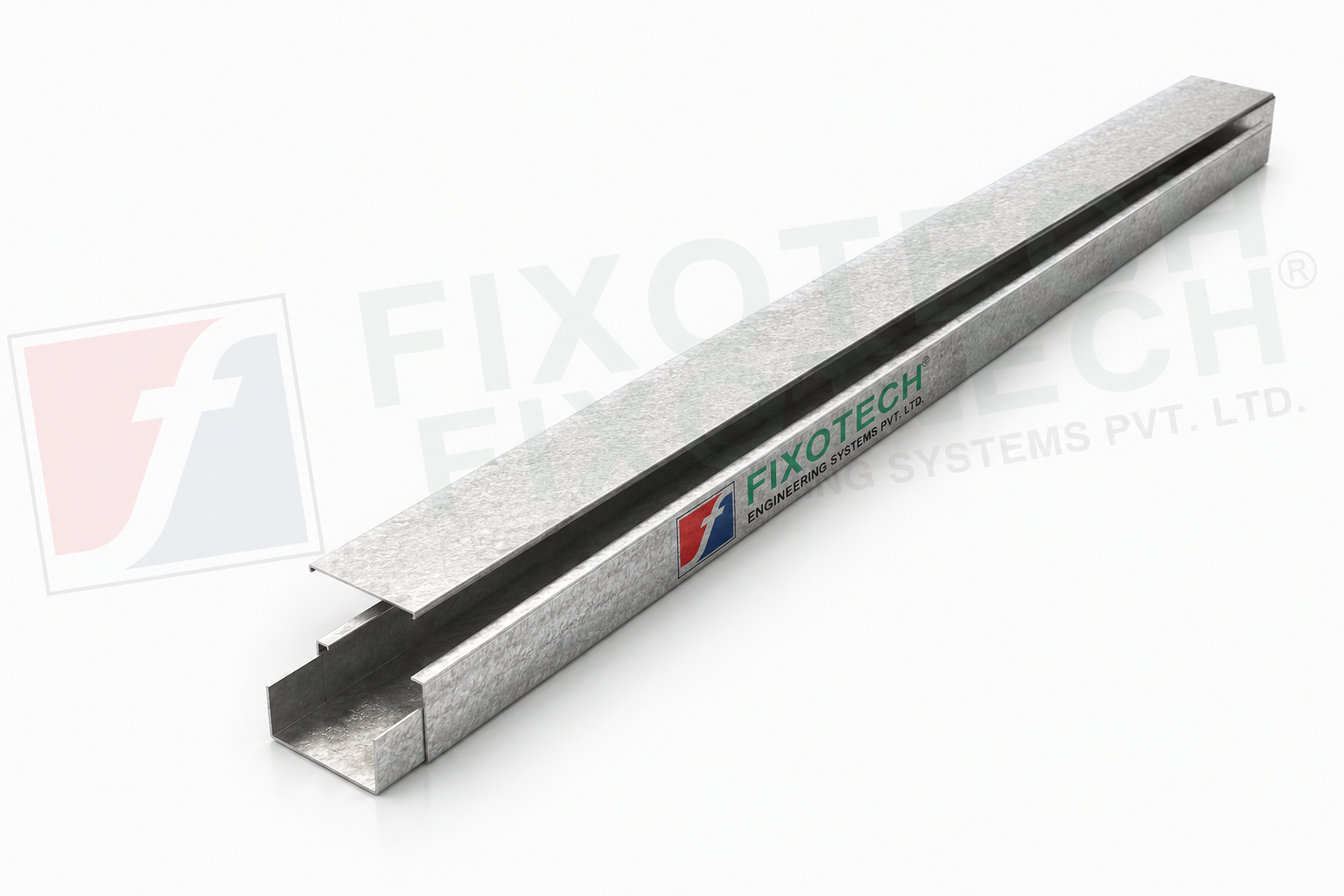 | RACEWAY CABLE TRAY - FLOOR RACEWAY RACEWAY CABLE TRAY - FLOOR RACEWAY A cable management system called a floor raceway cable tray, or just a floor raceway, is used to route and safeguard wires between floors, especially... View product → |
Frequently asked questions
When should you choose a floor raceway for between-floor cable routing?
Choose a floor raceway when cables need an enclosed or flush-mounted route within or across floors. Use conduit for smaller individually protected routes, ceiling raceway for overhead services, underfloor trunking for an accessible void, and raised-floor systems when panels and pedestals are coordinated.
What details should the floor penetration and installation method include?
The installation detail should show the penetration size, sleeve or frame, sealing method, finished floor level, cover access, support points and fire-stopping arrangement. Coordinate the detail with the structural slab, floor finish and cable-pulling sequence.
How do you calculate floor raceway capacity and bend space?
List each cable’s outside diameter, quantity and future allowance, then compare the combined area with the raceway’s usable internal area. Check the manufacturer’s minimum bend radius and provide enough straight length and access at every change of direction.
How should cable services and electrical continuity be managed?
Separate power, control, instrumentation and data services using partitions or independent compartments. Specify bonded joints, continuity across covers and joints, and an earthing connection where the installation design requires the raceway to provide a metallic conductive path.
What should you specify for material, finish, moisture protection and floor finish?
State the raceway material, coating or finish, corrosion exposure, cover type, ingress protection requirement, drainage provisions and compatibility with the finished floor. Confirm the finished height, loading, joint tolerances and replacement access before ordering.